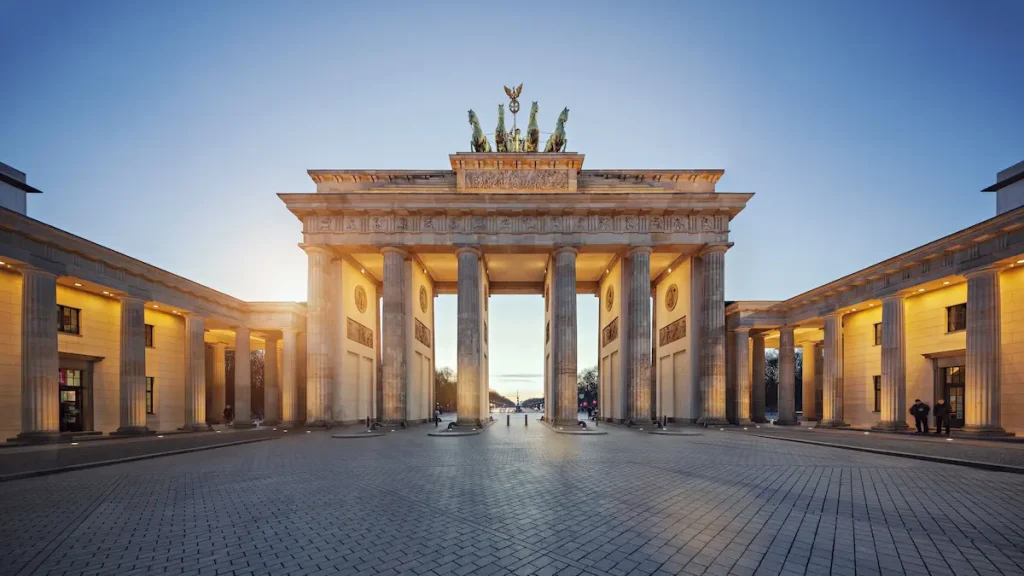
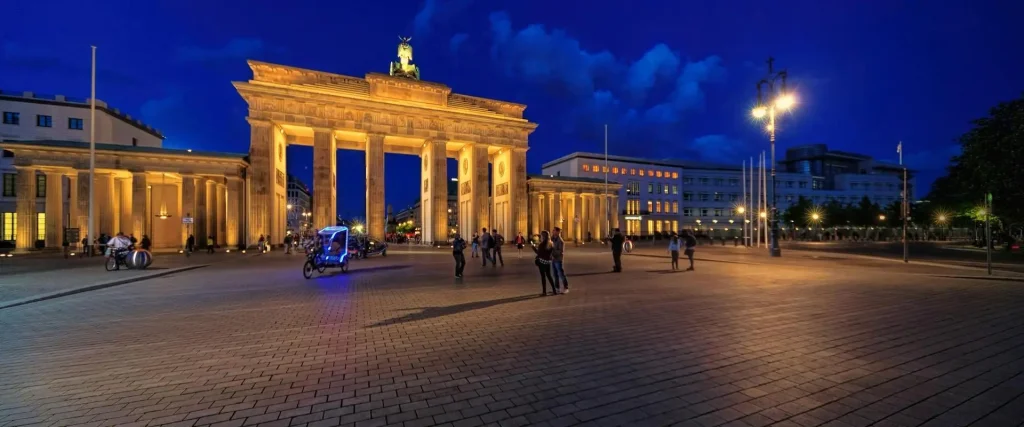
Stand before the Brandenburg Gate at dusk, the sky fading from gold to deep blue behind the quadriga of horses that crowns it, and you feel the full weight of what this extraordinary structure represents. For over two centuries, this neoclassical triumphal arch has stood at the heart of Berlin, witnessing — and in some ways embodying — the full drama of German and European history. It has been a symbol of Prussian power, Nazi appropriation, Cold War division, and, ultimately, of reunification and hope. There is no more fitting place to begin a visit to Berlin, and no more powerful place to end it. The Brandenburg Gate is, quite simply, one of the great monuments of the modern world.
History of the Brandenburg Gate
The Brandenburg Gate was built between 1788 and 1791, commissioned by King Frederick William II of Prussia as a symbol of peace and as a grand ceremonial entrance to the city of Berlin. Designed by architect Carl Gotthard Langhans, it was modelled on the Propylaea — the gateway to the Acropolis in Athens — and built in the neoclassical style that was then at the height of fashion across Europe. Twelve Doric columns support the entablature and the attic, and the entire composition is one of the finest examples of neoclassical architecture in Germany.
Atop the gate sits the Quadriga — a sculpture of the goddess Victoria driving a chariot pulled by four horses, designed by Johann Gottfried Schadow. The Quadriga became a symbol of Prussian pride and power, and its fate became entangled with the city’s history in fascinating ways. Napoleon famously had it removed and shipped to Paris after his victory over Prussia in 1806 — it was returned to Berlin eight years later, after his defeat, with a new addition: an Iron Cross and Prussian eagle added to Victoria’s laurel wreath.
Through the 19th century, the Brandenburg Gate served as the ceremonial entrance for great processions and events: royal weddings, military victories, and state funerals all passed beneath its arch. It was at the centre of Berlin’s most important public occasions, a focal point for the city’s collective life.
The Gate in the Nazi Era and World War II
The Nazi regime, with its appetite for monumental symbolism, adopted the Brandenburg Gate enthusiastically as a backdrop for their mass events and torchlight processions. The transformation of one of Berlin’s great symbols of peace and civic pride into a prop for totalitarianism was one of the many ways in which the Nazis appropriated German culture and architecture to their purposes.
By the end of World War II, the Brandenburg Gate had been badly damaged by bombing and artillery fire. It stood in the heavily destroyed no-man’s land between the Soviet and British sectors of occupied Berlin — a bullet-scarred ruin that somehow remained standing when so much of the city around it had been reduced to rubble. It was repaired in the 1950s, with the East German authorities removing the Iron Cross and eagle from the restored Quadriga — these were not returned until after reunification.
The Cold War: A Symbol of Division
The Brandenburg Gate’s most potent symbolism in the 20th century came from its role in the Cold War. When the Berlin Wall was built in August 1961, it ran right in front of the gate, placing it in the death strip between East and West Berlin — visible from both sides, lit by floodlights at night, but accessible to neither. For 28 years, the gate stood in no-man’s land, a reminder of everything that division had severed.
The area in front of the gate, on the Western side, became a place of political and emotional significance. It was here that John F. Kennedy came in 1963 to deliver his famous “Ich bin ein Berliner” speech — though he delivered that speech from the Schöneberg town hall, his visit to the Wall near the gate was the defining image. It was here that Ronald Reagan stood in 1987 and delivered his famous demand: “Mr Gorbachev, tear down this wall!” These moments, with the gate as backdrop, cemented its status as the defining symbol of the Cold War division of Europe.
November 1989: The Gate Reopened
When the Berlin Wall fell on 9 November 1989, the Brandenburg Gate was the scene of the most jubilant and emotionally overwhelming celebrations in Berlin’s history. Crowds gathered on both sides, people climbed on top of the Wall, and on 22 December 1989 — six weeks after the Wall’s fall — the gate was formally reopened for the first time since 1961. Helmut Kohl, the German Chancellor, walked through it in a scene of genuine historic emotion, flanked by thousands of jubilant Berliners from both east and west.
Since reunification, the Brandenburg Gate has served as the symbolic heart of a united Berlin and a united Germany. It has been the backdrop for the city’s New Year celebrations, for the FIFA World Cup victory celebrations in 2014, for concerts, demonstrations, and public gatherings of every kind. It is the place Berliners come to mark great moments in their collective life — and it has lost none of its power to move.
Visiting the Brandenburg Gate Today
The Brandenburg Gate stands at the eastern end of the Tiergarten on the Pariser Platz — a beautiful formal square that was completely rebuilt after the Cold War. The square is now lined with embassies, banks, and the legendary Hotel Adlon, and its calm, elegant proportions make it one of the finest urban spaces in Berlin. The gate itself is floodlit dramatically at night and makes for some of the most atmospheric photography in the city.
The gate is freely accessible at all times — you can walk through its central passage at any hour of the day or night. There is a visitor information room inside one of the gate’s flanking buildings, open during the day, where you can learn more about its history. The Reichstag is just a short walk to the north, and the Holocaust Memorial is just south of the gate — together, these three sites form an extraordinarily powerful historical cluster that can be visited in a single morning or afternoon.
The area around the gate is busy with tourists at all hours, and you will inevitably share the space with large crowds. The best times to visit for photography and a sense of space are early morning — just after dawn — or late at night. In the early morning light, with few people around and the Quadriga gleaming above, the gate reveals its full grandeur most completely.
What to See Nearby
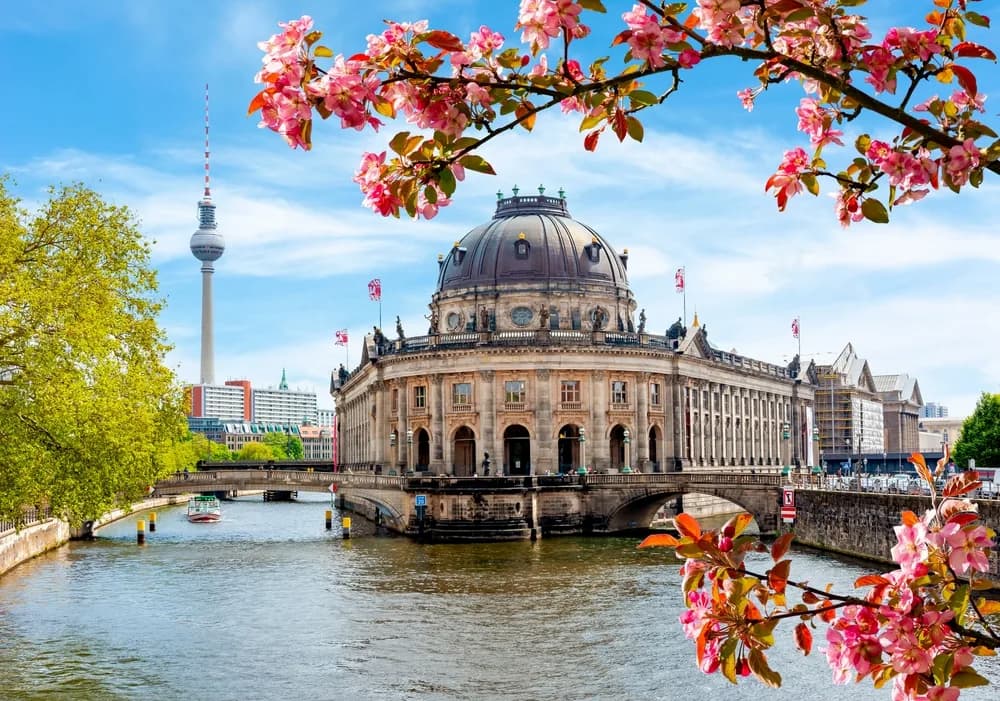
The Brandenburg Gate sits at the confluence of several of Berlin’s most important sights and neighbourhoods. Walking east along Unter den Linden takes you through the heart of historic Berlin Mitte to Museum Island. Heading north, the Reichstag and the government quarter are five minutes away. To the south, the Holocaust Memorial and then the diplomatic district. To the west, the Tiergarten unfolds in its full 210-hectare expanse.
The Checkpoint Charlie museum and crossing are about 20 minutes’ walk to the south, through streets that still bear the marks of the Cold War division. And the East Side Gallery and Berlin Wall Memorial are accessible by public transport for those who want to explore the Wall’s history in more depth.
For the best restaurants near the Brandenburg Gate, see our Berlin restaurant guide. For bars and evening entertainment in the area, see our Berlin bars guide. And for all transport information, visit our page on getting around Berlin.
Practical Information
The Brandenburg Gate is located on Pariser Platz in central Berlin and is open to visitors at all times. There is no admission charge. The nearest S-Bahn and U-Bahn station is Brandenburger Tor, served by lines S1, S2, S25, and U55. Bus lines 100 and 200, the city’s famous sightseeing bus routes, both stop at the gate.
The Brandenburg Gate: Where Berlin’s Story Lives
In a city full of extraordinary monuments and memorials, the Brandenburg Gate stands apart. It has been present for so much of the history that made Berlin what it is — the wars, the tyrannies, the division, the miraculous moment of reunification — and it carries all of that history in its stones without being crushed by it. Standing here, you are standing at the exact place where modern German history has been most continuously, most dramatically present. That is a rare and powerful thing, and it is why a visit to the Brandenburg Gate is not just an item to tick off a tourist list but a genuine encounter with history. Come prepared to feel something. You will not be disappointed.
Discover more of what Berlin has to offer at GoVisitBerlin.com.