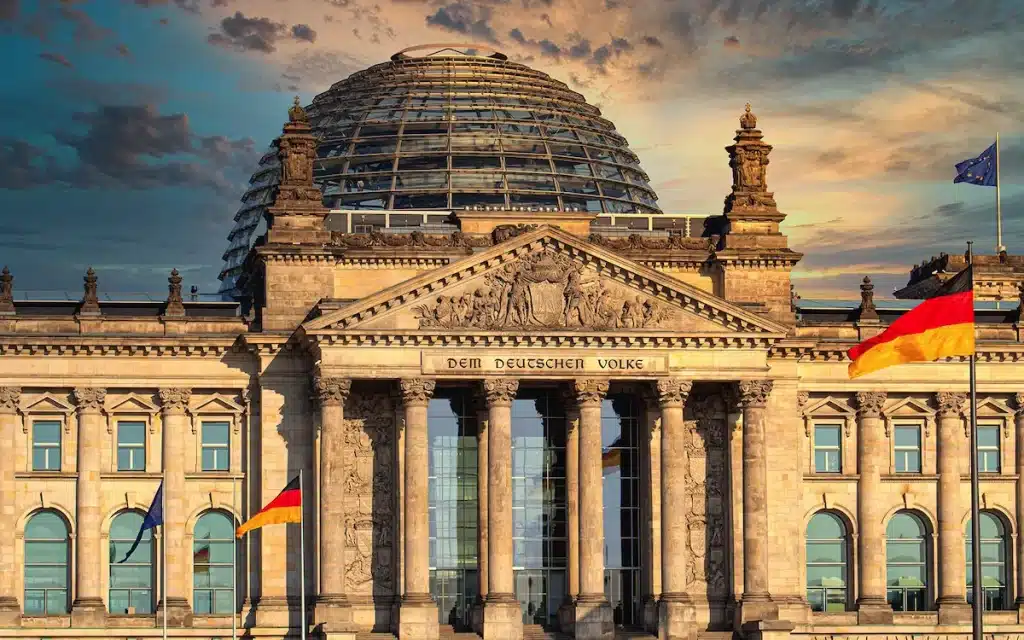
There is no building in Berlin — perhaps in all of Germany — that carries more historical weight than the Reichstag. This vast neoclassical parliament building on the banks of the Spree has witnessed more of the 20th century’s defining moments than almost any other structure in Europe: the proclamation of the German Republic, the devastating fire that helped Hitler consolidate power, the ferocious battles of 1945, the poignant decades of division, and the triumphant reunification of Germany. Today, rebuilt and reimagined with Norman Foster’s iconic glass dome, it is not just a functioning seat of democracy but one of the most visited and most rewarding attractions in Berlin. And the best part? Admission is completely free.
Visiting the Reichstag is one of those rare travel experiences that combines architectural wonder, historical depth, and genuine political meaning in a single, extraordinary place. If you only have time for one attraction in Berlin Mitte, make it this one.
The History of the Reichstag
The Reichstag building was constructed between 1884 and 1894 to house the Imperial German parliament. Its architect, Paul Wallot, designed a massive, ornate structure in the German Renaissance style, topped by a large glass and steel dome that was one of the engineering marvels of its day. The inscription above the main entrance — “Dem Deutschen Volke” (To the German People) — was added in 1916, during World War I, as a statement of the building’s democratic purpose.
The most consequential moment in the building’s history came on the night of 27 February 1933, when the Reichstag caught fire. A young Dutch communist named Marinus van der Lubbe was arrested at the scene and convicted of arson. Whether he acted alone, was manipulated by the Nazis, or was entirely innocent remains historically disputed. What is not disputed is the use Hitler made of the fire: within 24 hours, emergency legislation had been passed suspending civil liberties across Germany, and the Nazis began using the “communist threat” as justification for a sweeping seizure of power. The Reichstag fire was one of the pivotal events of the 20th century.
The building was badly damaged in the fire and further reduced to a shell by the fighting of April–May 1945. For decades it stood as a gutted ruin in the no-man’s land of the divided city — used occasionally for exhibitions and events but largely symbolic. After reunification, the Bundestag voted to move the German parliament back to Berlin, and the Reichstag was chosen as its home. The reconstruction project, led by British architect Norman Foster, resulted in one of the most celebrated works of contemporary architecture in Europe.
Norman Foster’s Glass Dome
The defining element of the reconstructed Reichstag — and the reason most visitors come — is the spectacular glass dome that sits atop the building. Foster’s design is a work of genius: a lightweight, transparent hemisphere containing a mirrored cone at its centre that channels natural light down into the parliamentary chamber below. Visitors walk up two intertwining ramps that spiral around the inside of the dome, reaching a viewing platform at the top with 360-degree panoramic views across Berlin.
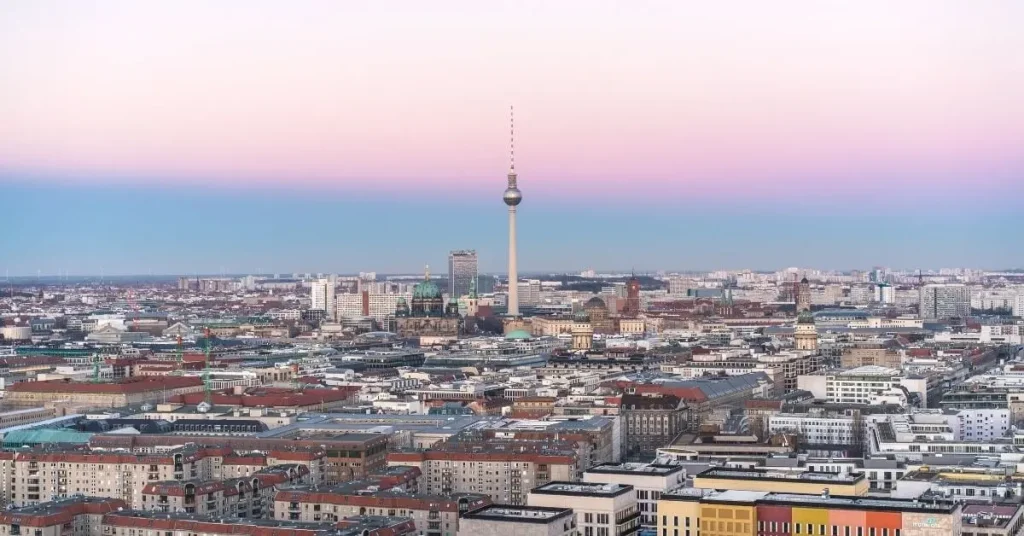
The experience of being inside the dome is unlike anything else in Berlin. Looking down through the dome’s transparent floor into the Bundestag chamber below, you see Germany’s parliament in session — the people’s representatives visible to the people themselves, a powerful architectural statement about transparency in democracy. At the same time, the views outward across the city are spectacular: the Tiergarten, the Brandenburg Gate, the TV Tower, and on clear days the entire sweep of the Berlin skyline.
The dome is open from 8am until midnight (last entry 10pm), and on clear evenings the experience of watching the sun set over Berlin from the dome is one of the great travel moments the city offers. An audio guide is included with admission and provides commentary on both the architecture and the view as you ascend the ramp.
The Rooftop Terrace
In addition to the dome, the Reichstag’s rooftop terrace offers an extraordinary outdoor experience with panoramic views across the city. The Käfer restaurant on the rooftop — one of the most unusually located restaurants in Europe — serves lunch and dinner and makes for a memorable meal with arguably the best views of any restaurant in Berlin. Reservations are essential and should be made well in advance.
How to Book Your Visit
This is the most important practical note about visiting the Reichstag: you must book in advance. The building is a functioning seat of government with strict security requirements, and walk-in visitors are not admitted. Registration must be done online through the Bundestag’s official website, and you will need to provide your passport details for all members of your group. The good news is that admission is entirely free — the registration is simply a security requirement.
During busy periods — spring and summer especially — slots can book up weeks in advance, so plan ahead. If you have not pre-booked and arrive in Berlin spontaneously, it is worth checking the website for last-minute availability, as cancellations do occur. Visitors without pre-booked slots can sometimes obtain same-day tickets from the Reichstag’s visitor centre on the west side of the building — arrive early for the best chance.
Bring your passport or ID card on the day of your visit — security checks are thorough. Large bags and certain items are not permitted inside; there are lockers available near the entrance. The visit to the dome takes around 30–45 minutes for most visitors, though you can stay longer if you wish.
The Art in the Reichstag
Beyond the architecture, the Reichstag contains a remarkable collection of contemporary art commissioned specifically for the building’s interior spaces. These works — by artists including Gerhard Richter, Sigmar Polke, and many others — engage directly with the building’s history and the themes of German democracy, memory, and identity. They are viewable only during scheduled guided tours of the interior, which must be booked separately from the dome visit and are available in several languages. If art and architecture are among your interests, these tours are highly recommended.
One of the most iconic artistic interventions in the building’s history took place before its reconstruction, when the artists Christo and Jeanne-Claude wrapped the entire Reichstag in 100,000 square metres of shimmering silver fabric in June 1995. The images of the “Wrapped Reichstag” — the building transformed into a mysterious, luminous object — are among the most memorable in contemporary art history.
The Government Quarter
The Reichstag sits at the heart of Berlin’s government quarter, a remarkable ensemble of contemporary architecture that has grown up around the bend of the Spree since reunification. The Federal Chancellery — the largest government building in the world, popularly known as the “washing machine” for its distinctive circular window elements — is just across the river. The Paul-Löbe-Haus and Marie-Elisabeth-Lüders-Haus, the two parliamentary office buildings that flank the Reichstag, are connected by a bridge across the Spree that represents the reunification of the city’s two banks. Walking through this government quarter is to experience a bold statement of democratic architecture that rewards attention.
Getting to the Reichstag
The Reichstag is located on Platz der Republik, just west of the Brandenburg Gate. The nearest S-Bahn and U-Bahn station is Brandenburger Tor (lines S1, S2, S25, U55). The main Berlin station, Hauptbahnhof, is also just a short walk to the north. The Tiergarten park begins immediately to the west, making the Reichstag a natural starting or finishing point for a walk through the park. For full transport advice, see our guide to getting around Berlin.
The Reichstag: History Made Visible
The Reichstag is not just a tourist attraction — it is a living parliament, a functioning democracy, and a building that has survived and witnessed more than almost any other structure in Europe. Visiting it is an act of engagement with history: you are standing where the republic was proclaimed, where a fire changed the course of the 20th century, where Soviet soldiers hoisted their flag in May 1945, and where a reunified Germany made its home. Norman Foster’s dome, rising above all that history in a spirit of transparent optimism, is one of the most perfectly judged architectural statements of the modern era.
Book early, arrive ready to be moved, and look down through the dome at the parliament below. That image — the people looking down on their representatives, the representatives visible to the people — encapsulates something important about what Germany has built from the ruins of its history. It is worth travelling a long way to see.
Explore more of what Berlin has to offer at GoVisitBerlin.com, and check our Berlin travel tips for all the practical advice you need.