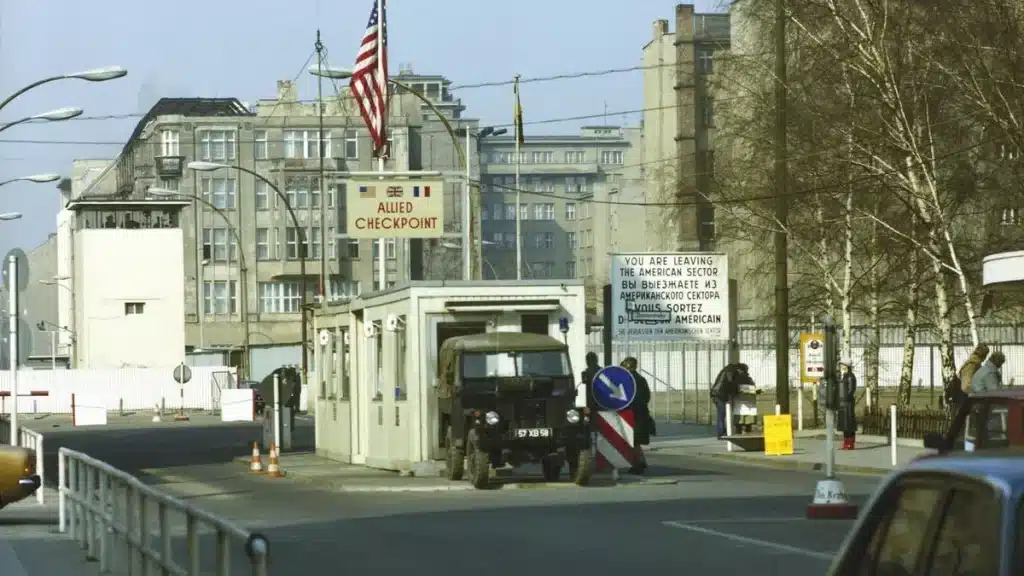
Few addresses in the world carry the historical charge of Checkpoint Charlie. This small intersection in the heart of Berlin Mitte — where Friedrichstrasse crosses the former line between the American and Soviet sectors of divided Berlin — was, for 28 years, one of the most tense and consequential border crossings on earth. It was here that Allied military personnel crossed between the two halves of the divided city, that diplomats passed in armoured cars, that spies were exchanged in nerve-wracking handovers, and that ordinary East Germans risked their lives in desperate bids for freedom. Today, Checkpoint Charlie is one of Berlin’s most visited tourist sites — and understanding why it matters is essential to understanding Berlin itself.
The name “Charlie” comes simply from the NATO phonetic alphabet: Alpha designated the border crossing at Helmstedt, Bravo the one at Dreilinden, and Charlie this one, in the middle of the city. It was the only crossing point in Berlin open to Allied military and to Western civilians, which gave it an outsized importance in the daily drama of the Cold War.
The History of Checkpoint Charlie
Checkpoint Charlie came into being on 13 August 1961, the same night the Berlin Wall was erected. As the East German regime began sealing the city’s borders, the Allied powers insisted on maintaining their rights of access across the sector boundaries, and Checkpoint Charlie became the designated crossing point for this purpose. In the early days, tensions were almost unbearably high.
The most dangerous episode came in October 1961, just weeks after the Wall was built. Following a dispute over whether East German guards had the right to check the papers of American diplomats, a standoff developed at Checkpoint Charlie that escalated into one of the most alarming confrontations of the Cold War. For 16 hours, American and Soviet tanks faced each other barrel-to-barrel at the checkpoint, the two superpowers separated by just a hundred metres of tarmac. It was, many historians argue, the closest the Cold War came to turning hot in Europe. Eventually, through back-channel diplomacy, the tanks withdrew — but the episode showed how explosive the situation in divided Berlin truly was.
Over the following decades, Checkpoint Charlie was the scene of numerous dramatic escape attempts. East Germans hid in car boots, in specially constructed compartments under vehicles, in suitcases, in the boots of motorcycles. Some bribed or impersonated Western citizens. Some attempts succeeded; others ended in capture, imprisonment, or death. The stories of these escapes are among the most gripping chapters in the history of the divided city.
The Checkpoint Charlie Museum
The Haus am Checkpoint Charlie — the Checkpoint Charlie Museum — is one of Berlin’s most visited and most discussed museums. Founded in 1963 by Rainer Hildebrandt, a tireless campaigner for human rights under communism, the museum documents the history of the Wall and the many ingenious and courageous escape attempts made by East Germans. The collection includes the actual vehicles, contraptions, and devices used in real escape attempts — tiny cars with specially built hiding spaces, a hot air balloon used by two families, homemade submersibles, and much more.
The museum’s tone is passionate and advocacy-driven rather than academic, and some visitors find its presentation dated and chaotic. But the stories it tells are genuinely extraordinary, and the sheer human ingenuity and desperation on display in the escape exhibits is deeply moving. It is best visited alongside the more rigorous historical exhibitions at the Berlin Wall Memorial on Bernauer Strasse, which provides the broader context that the Checkpoint Charlie Museum sometimes lacks.
The Outdoor Exhibition
Even without entering the museum, Checkpoint Charlie rewards a visit. The outdoor exhibition — a series of large-format panels lining the pavement on both sides of Friedrichstrasse — provides a free, accessible, and informative account of the Wall’s history, the crossing’s significance, and the human stories of division and escape. The panels cover everything from the building of the Wall to the tank standoff, from the mechanics of the border fortifications to the biographies of individuals who risked and sometimes lost their lives trying to cross them.
The replica guardhouse at the crossing — the white-painted sentry box that has become one of the most photographed objects in Berlin — stands as a tourist focal point, with uniformed “guards” offering to pose for photos (a tip is expected). It is worth noting that this guardhouse is a modern replica, not the original — the original was removed in 1990. The commercialisation around Checkpoint Charlie is heavy, and opinions divide on whether it is appropriate to the site’s gravity. But beneath the tourism, the history is real and powerful.
Espionage and Exchange: The Glienicke Bridge Connection
Checkpoint Charlie is associated not just with escape attempts but with one of the most glamorous and cinematic aspects of Cold War history: spy exchanges. During the Cold War, Berlin was the espionage capital of the world, with agents from every intelligence service operating in the divided city. When spies were captured by the opposing side, their return was sometimes negotiated through prisoner exchanges — and these exchanges became some of the most dramatic episodes of the Cold War era.
While the most famous spy exchanges took place at the Glienicke Bridge in Potsdam — the subject of Steven Spielberg’s film “Bridge of Spies” — Checkpoint Charlie was also used for several notable exchanges. The atmosphere of the Cold War spy world is still palpable in this part of Berlin, and for those interested in Cold War history, a visit to Checkpoint Charlie combined with a day trip to Potsdam makes for an extraordinarily rich historical experience. Read our full Potsdam day trip guide to plan the combination.
The Topography of Terror: Essential Context
Just a few minutes’ walk from Checkpoint Charlie, the Topography of Terror documentation centre stands on the former site of the Gestapo and SS headquarters. For anyone seeking to understand the full sweep of 20th-century German history — from the Nazi terror that helped precipitate the war and the division that followed it — the Topography of Terror is essential. Its exhibition is one of the most rigorous and honest accounts of National Socialist rule available anywhere, and entry is free. The outdoor section of the exhibition also runs along a preserved section of the Berlin Wall itself, providing a direct visual connection between the Nazi era and the Cold War division. Our Berlin museums guide covers this and many other important institutions.
Jewish Museum Berlin: Nearby and Essential
A short walk south of Checkpoint Charlie, the Jewish Museum Berlin is one of the most powerful and architecturally extraordinary museums in Germany. Designed by Daniel Libeskind in a dramatic deconstructivist building whose zinc-clad facade, slanting walls, and deliberately disorienting interior spaces are themselves a form of historical commentary, the museum traces two millennia of Jewish life in Germany with extraordinary depth and humanity. The building alone is worth the visit — the voids, the Holocaust Tower, the Garden of Exile are among the most affecting architectural experiences in any museum in the world. See our guide to Berlin museums for more.
Visiting Checkpoint Charlie: Practical Information
Checkpoint Charlie is located on Friedrichstrasse in Mitte, easily reachable by U-Bahn line U6 (Kochstrasse stop, one stop from Checkpoint Charlie) or U2 (Stadtmitte). It is open to visit at any time — the outdoor exhibition is always accessible and free. The Checkpoint Charlie Museum charges admission and is open daily. The area can be very busy with tourists, particularly in summer, and is best visited in the morning before the crowds build up.
Checkpoint Charlie sits at the heart of a rich cluster of historical sites. The Holocaust Memorial and the Brandenburg Gate are a 15-minute walk north. The East Side Gallery is accessible by U-Bahn to the east. And for the best overview of Berlin’s Cold War history in physical form, the Berlin Wall Memorial on Bernauer Strasse is a short U-Bahn journey to the north. For transport advice, see our guide to getting around Berlin.
Checkpoint Charlie and the Memory of Division
Checkpoint Charlie is not the most serene or contemplative of Berlin’s historical sites — the commercialisation is real, the crowds are significant, and the replica guardhouse can feel jarring against the gravity of the history. But none of that diminishes the fundamental importance of this location and the stories it represents. Standing at this intersection, imagining the tanks facing each other in October 1961, picturing the desperation of those who risked everything to cross it, feeling the weight of the 28 years when this was the seam between two worlds — that is a genuinely powerful historical experience.
Berlin tells the story of the 20th century better than any other city, and Checkpoint Charlie is one of the places where that story is most vividly present. Visit it, read the outdoor exhibition carefully, perhaps go into the museum — and leave with a deeper understanding of what divided Europe meant, and what it meant when it ended.
For more on planning your Berlin visit, explore our Berlin travel tips and discover everything the city has to offer at GoVisitBerlin.com.