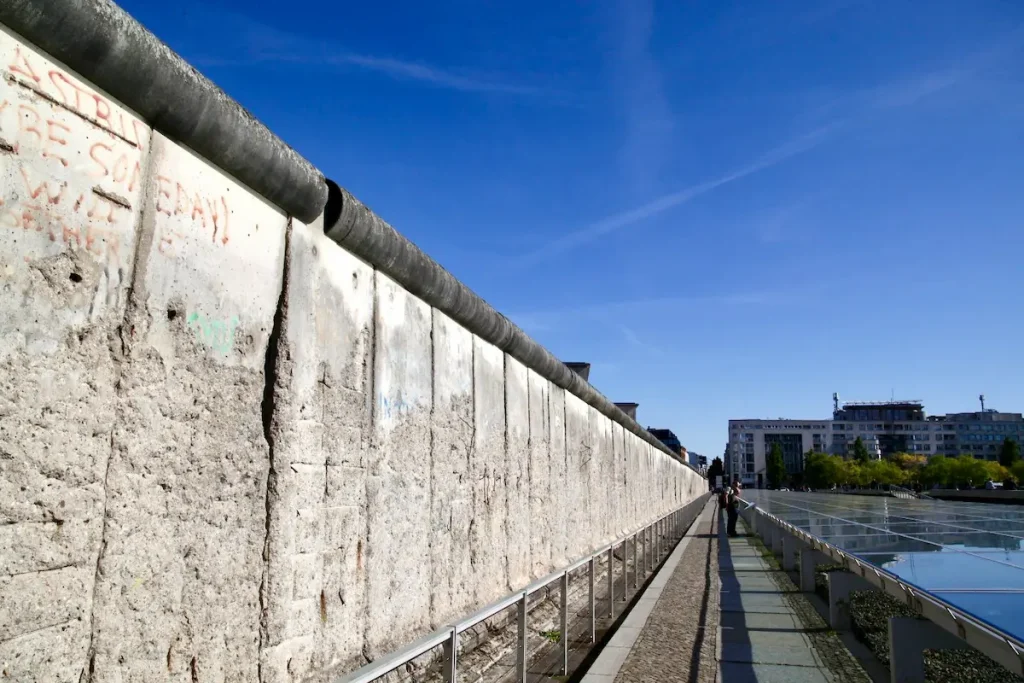
Few structures in modern history carry as much symbolic and emotional weight as the Berlin Wall. Built overnight in August 1961 and torn down in a wave of popular euphoria in November 1989, the Wall divided not just a city but a country, a continent, and the world. It was the most tangible expression of the Iron Curtain — a barrier of concrete, barbed wire, floodlights, and deadly force that separated families, imprisoned millions, and became the defining symbol of the Cold War. Today, visiting the sites that preserve and commemorate the Wall’s history is one of the most powerful and essential experiences Berlin has to offer.
Walking the Wall’s former course — tracing the ghost of that barrier through streets, parks, and neighbourhoods that have long since been reunified and rebuilt — is to walk through one of the most significant chapters of 20th-century history. It is sobering, moving, and at times unexpectedly beautiful. And in the way that Berlin’s history so often does, it speaks not just of the past but of what human beings are capable of — both in building such a thing, and in tearing it down.
The History of the Berlin Wall
By the summer of 1961, over three million East Germans had fled to the West through Berlin — the one gap in the Iron Curtain where East and West still met in a divided but still-porous city. The haemorrhage of citizens — disproportionately young, skilled, and educated — was threatening to economically collapse the German Democratic Republic. On the night of 12–13 August 1961, the East German regime, with Soviet approval, began sealing the border. What began as barbed wire and improvised barriers was rapidly replaced by concrete, watchtowers, anti-vehicle trenches, and an elaborate system of fortifications that grew more sophisticated over the following decades.
The Wall ultimately stretched for 155 kilometres around West Berlin, encircling it entirely. The death strip between the inner and outer walls was patrolled by guards with orders to shoot to kill anyone attempting to cross. At least 140 people were killed at the Wall — and possibly many more, depending on how the boundaries of the Wall system are defined. Countless others were imprisoned for attempting to escape. For 28 years, the Wall stood as a symbol of everything that was wrong with the division of Europe.
When it fell — not by design but through a cascade of popular protest, political miscommunication, and sheer human pressure — the scenes of jubilation, of families reunited, of people dancing on top of the Wall and hacking at it with pickaxes, were among the most emotionally overwhelming in modern history.
The Berlin Wall Memorial on Bernauer Strasse
For the most complete and moving experience of the Wall and its history, the Berlin Wall Memorial (Gedenkstätte Berliner Mauer) on Bernauer Strasse is essential. This memorial preserves a 1.4-kilometre section of the Wall in its full, extraordinary complexity — not just the concrete panels that tourists usually think of, but the entire border fortification system: the inner wall, the death strip, the outer wall, the watchtower, the anti-vehicle ditch, and the lighting installation. Standing here, you understand for the first time what the Wall actually was — not a single barrier but a system engineered for maximum lethality.
The memorial includes an outdoor exhibition along the length of the preserved section, with information panels, photographs, and personal testimonies documenting the Wall’s construction, the lives of those who tried to cross it, and the stories of the neighbourhood of Bernauer Strasse itself — where the Wall ran right through the middle of the street, with apartment buildings on the eastern side bricked up and their residents eventually expelled. A documentation centre at the northern end of the memorial offers a deeper exploration of the Wall’s history through films, photographs, and artefacts. Entry to both the outdoor memorial and the documentation centre is free.
The East Side Gallery
While the Bernauer Strasse memorial gives you the history, the East Side Gallery gives you the art — and it is one of the most remarkable outdoor gallery experiences in the world. This 1.3-kilometre stretch of the original Wall, running along the Spree in the Friedrichshain neighbourhood, was painted in 1990 by over 100 artists from 21 countries in a spontaneous, joyful celebration of the Wall’s fall and the freedoms it represented.
The murals range from the politically explicit to the poetically abstract, from the deeply personal to the universal. The most famous image — Dmitri Vrubel’s painting of Soviet leader Leonid Brezhnev and East German leader Erich Honecker locked in a fraternal kiss — has become one of the iconic images of the 20th century. But there are dozens of other powerful and beautiful works here, and walking the full length of the gallery is both an artistic and a historical experience.
The East Side Gallery is free, open around the clock, and located right on the banks of the Spree near Ostbahnhof and Warschauer Strasse. It is worth noting that the murals are on the actual original Wall and are exposed to the elements — some have faded or been damaged over the decades, and conservation efforts have been ongoing.
Checkpoint Charlie
The most famous crossing point between East and West Berlin during the Cold War, Checkpoint Charlie has become one of the city’s most iconic tourist sites. Located in Mitte, near the border between the former American and Soviet sectors, this is where Allied military personnel and diplomats crossed between the two halves of the divided city. The original guardhouse is long gone — the one standing today is a modern replica — but the outdoor exhibition that lines the street tells the compelling and often hair-raising story of the crossing’s history. For the full story, visit our dedicated Checkpoint Charlie guide.
Topography of Terror
Just steps from Checkpoint Charlie, the Topography of Terror documentation centre stands on the former site of the Gestapo and SS headquarters — the nerve centre of the Nazi terror apparatus. The exhibition, spread across an indoor hall and an extensive outdoor section along a preserved stretch of the Wall itself, documents both the history of National Socialist persecution and the history of the specific site where so much of that persecution was planned and ordered. It is one of the most rigorously honest and important historical exhibitions in Germany, and entry is free. No visit to this part of Berlin is complete without it.
Tracing the Wall’s Course Through the City
For those who want to follow the Wall’s former path in a more active way, a marked cycling and walking route — the Berlin Wall Trail (Berliner Mauerweg) — traces the entire 155-kilometre course of the Wall around what was once West Berlin. The full route takes several days to complete by bicycle, but shorter sections can be done as half-day excursions. Double cobblestone lines embedded in streets and pavements across the city also mark the Wall’s former course — look down as you walk through Berlin and you will spot them.
Cycling the Wall trail is a wonderful way to see the less-visited parts of Berlin, passing through quieter residential neighbourhoods, parkland, and former border zones that still bear the marks of division. For transport and cycling advice, see our guide to getting around Berlin.
Visiting the Berlin Wall: Practical Information
All the major Wall-related sites — the Bernauer Strasse Memorial, the East Side Gallery, the Topography of Terror, and the outdoor areas of Checkpoint Charlie — are free to visit. The Checkpoint Charlie Museum charges admission. The Bernauer Strasse Memorial is open daily; the Documentation Centre there has specific opening hours and is closed on Mondays. The East Side Gallery is always open.
For context on the broader history of Cold War Berlin, the DDR Museum near Museum Island offers an entertaining and interactive look at everyday life in East Germany. And for the full spectrum of Berlin’s historical museums, visit our guide to Berlin museums.
The Wall Today: Memory and Meaning
More than three decades after its fall, the Berlin Wall remains a profoundly live presence in the city. The physical traces are fragmentary — preserved in memorials, painted as murals, embedded in pavements — but the Wall’s meaning continues to resonate. Berlin has chosen not to erase this history but to engage with it honestly, to remember the suffering it caused and to ensure that the stories of those who lived under and died at it are never forgotten.
For visitors, the Wall offers a way into one of the most extraordinary stories of the 20th century — and Berlin tells that story better than anywhere else. Come, walk the memorial, stand at the East Side Gallery, trace the cobblestone line in the pavement. You will leave with an understanding of this city, and of recent history, that will stay with you for a very long time.
For more on planning your Berlin visit, see our Berlin travel tips, our guide to the best time to visit, and the full overview at GoVisitBerlin.com.