If you want to understand what makes Berlin different from every other European capital — rawer, freer, more creatively alive — then Kreuzberg is the place to start. This legendary neighbourhood in south-central Berlin has been the city’s beating countercultural heart for decades, and it shows no signs of losing its edge. From canal-side Turkish food stalls to legendary nightclubs, from extraordinary street art to one of the best outdoor markets in Germany, Kreuzberg is the neighbourhood that gave Berlin its reputation, and it remains absolutely essential visiting.
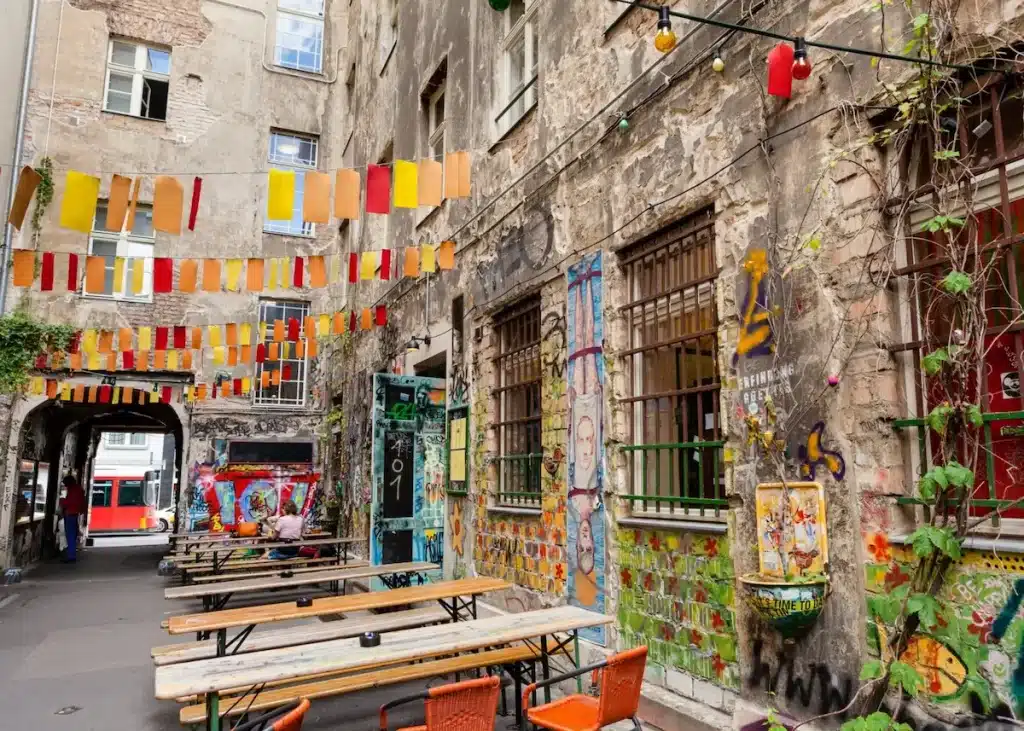
Kreuzberg is not a neighbourhood that poses for photographs. It is lived-in, layered, and wonderfully imperfect. Buildings still bear the marks of history, graffiti covers every surface that will accept paint, and the air smells alternately of döner kebab, freshly ground coffee, and the River Spree. It is also one of the most ethnically diverse neighbourhoods in Germany, shaped above all by the large Turkish and Kurdish community that has called Kreuzberg home since the 1960s — and whose culinary, cultural, and social influence has made the neighbourhood what it is today.
The Spirit of Kreuzberg: A Brief History
Kreuzberg’s character was shaped by its geography and its politics. During the Cold War, the neighbourhood sat right up against the Berlin Wall — surrounded on three sides by the barrier, cut off from the rest of West Berlin, and priced cheaply enough to attract artists, squatters, political radicals, and immigrants. The Turkish guest workers who arrived in large numbers from the 1960s onwards settled here and in neighbouring Neukölln, transforming the area’s food, culture, and social fabric in profound ways. The squatter movements of the 1970s and 80s, the May Day protests, the radical politics — all of this gave Kreuzberg a spirit of resistance and independence that remains tangible today.
After reunification, when the Wall came down and land values began rising across the city, many predicted that Kreuzberg would gentrify beyond recognition. And while it has undeniably changed — with boutique hotels, specialty coffee shops, and upscale restaurants appearing alongside the traditional döner stalls and hardware shops — Kreuzberg has proven remarkably resilient. Its identity is too strong, its community too rooted, to be smoothed over entirely.
Görlitzer Park and the Canal
The social heart of Kreuzberg is arguably the Landwehrkanal, the canal that runs through the neighbourhood in a long, graceful curve. On warm days, the canal banks are lined with Berliners sitting, cycling, picnicking, and socialising in that unhurried, outdoor-loving way that is so characteristic of the city. The canal is beautiful in all seasons — in summer it sparkles, in autumn the overhanging trees blaze with colour — and the path along it is one of the finest urban walks in Berlin.
Görlitzer Park, a sprawling green space set in a former railway station yard, is one of the neighbourhood’s main gathering spots. It is rough around the edges, always lively, and beloved by locals. Weekend afternoons here are a wonderful slice of authentic Berlin life — families, musicians, football players, sunbathers, and street food vendors all coexisting in cheerful chaos. It is the kind of public space that only a city like Berlin produces.
The Turkish Market on Maybachufer
Twice a week — on Tuesdays and Fridays — the banks of the Maybachufer canal in Neukölln, just across the border from Kreuzberg, host what is arguably the best market in Berlin. The Turkish Market (Türkenmarkt) is a sensory extravaganza of colour, noise, and extraordinary food. Stalls overflow with olives, cheeses, fresh herbs, spices, flatbreads, grilled meats, baklava, seasonal vegetables, and bolts of fabric. The atmosphere is boisterous and festive, the prices are remarkably low, and the food is exceptional.
This market is not a tourist attraction — it is where the local community shops — and that authenticity is exactly what makes it so special. Come hungry, bring cash, and prepare to eat as you walk. It is one of the great free pleasures of visiting Berlin. For more food recommendations across the city, browse our guide to the best restaurants in Berlin.
Street Art and the Urban Canvas
Kreuzberg is an open-air gallery of some of the finest street art in Europe. Every wall, shutter, and underpass seems to bear some form of artistic expression — from elaborate murals that took teams of artists weeks to complete, to spontaneous tags and stencils that appeared overnight. The neighbourhood around Oranienstrasse, Skalitzer Strasse, and the streets running down to the canal are particularly rich in remarkable work.
The tradition of artistic expression here runs deep — Kreuzberg has always been a place where artists could find cheap studio space and a community of like-minded creatives — and the street art is an extension of that tradition into public space. Some of the world’s most celebrated street artists have left their mark here, and the constantly changing nature of the work means that every visit reveals something new. For more street art and urban culture, head east to the East Side Gallery, where the world’s largest open-air mural collection lines a remaining stretch of the Berlin Wall.
Eating and Drinking: Kreuzberg’s Extraordinary Food Scene
Kreuzberg might be the finest neighbourhood in Germany for eating well on a budget. The density of excellent, affordable restaurants from every culinary tradition is genuinely staggering. Turkish and Kurdish cuisine dominates — and deservedly so. The döner kebab served in Kreuzberg is a benchmark against which all others must be measured: the bread freshly baked, the meat slowly roasted on a vertical spit, the sauces made in-house, the vegetables piled high. It is one of the great street foods of the world, and you can eat magnificently for just a few euros.
Beyond Turkish food, Kreuzberg offers outstanding Vietnamese, Indian, Middle Eastern, and Italian restaurants alongside a growing number of innovative contemporary Berlin restaurants where chefs are doing genuinely exciting things with local and seasonal ingredients. The neighbourhood around Bergmannstrasse is particularly good for food and café culture, with a more relaxed, residential atmosphere than the busier streets further north.
For drinks, Kreuzberg has a legendary bar scene. The stretch of Oranienstrasse and Wiener Strasse is lined with bars ranging from grungy punk dives to elegant cocktail spots. Many open late and close very late — or not at all on weekends. For nightlife across the city, see our guide to Berlin bars and nightlife.
Viktoria Park and the Kreuzberg Hill
For a moment of calm and a spectacular view over the city, head to Viktoria Park — a lovely green space built around the Kreuzberg hill, the highest natural point in the flat inner city. At the summit stands a striking neo-Gothic monument commemorating the Prussian victories in the Napoleonic Wars, and the views from the top are wonderful, especially at sunset. A small waterfall cascades down the hillside in warmer months, and the park’s beer garden — one of the oldest in Berlin — is a wonderful spot for an afternoon beer. This is the neighbourhood at its most charming.
Berlinische Galerie
For a world-class museum experience within Kreuzberg, the Berlinische Galerie is a must. This superb museum of modern art, photography, and architecture focuses on Berlin-based artists and movements from the 20th century to the present day, and its collection is outstanding. The building — a converted glass warehouse — is itself a pleasure, and the programme of temporary exhibitions is consistently excellent. It is far less crowded than the major institutions on Museum Island and all the better for it.
Getting to Kreuzberg
Kreuzberg is easy to reach from anywhere in central Berlin. The U-Bahn lines U1, U6, U7, and U8 all pass through the neighbourhood, with stops at Görlitzer Bahnhof, Kottbusser Tor, Moritzplatz, and Mehringdamm among the most useful. The U-Bahn runs through the night on weekends, making getting home after a late night out simple. For full transport advice, see our guide to getting around Berlin.
Kreuzberg and the Wider City
Kreuzberg sits at the southern edge of central Berlin, close to many other great destinations. Mitte, with its historic landmarks and museums, is just to the north. The Tiergarten park is a short ride west. And Friedrichshain, with the East Side Gallery and its vibrant nightlife, is directly across the Spree. Kreuzberg also borders Neukölln to the south — another neighbourhood worth exploring for its markets, multicultural food scene, and up-and-coming arts spaces.
For help planning your overall Berlin trip, check our Berlin travel tips, the best time to visit, and the full overview on our GoVisitBerlin.com homepage.
Why Kreuzberg Is Unmissable
Kreuzberg is not polished, not predictable, and not for everyone — and that is precisely what makes it so special. In a world of increasingly homogenised city tourism, Kreuzberg remains stubbornly, gloriously itself. It is the neighbourhood that best embodies Berlin’s spirit of freedom, diversity, and creative energy, and a visit here will give you an understanding of this city that no amount of landmark-ticking can provide. Come with an open mind, comfortable shoes, and a healthy appetite. Kreuzberg will do the rest.