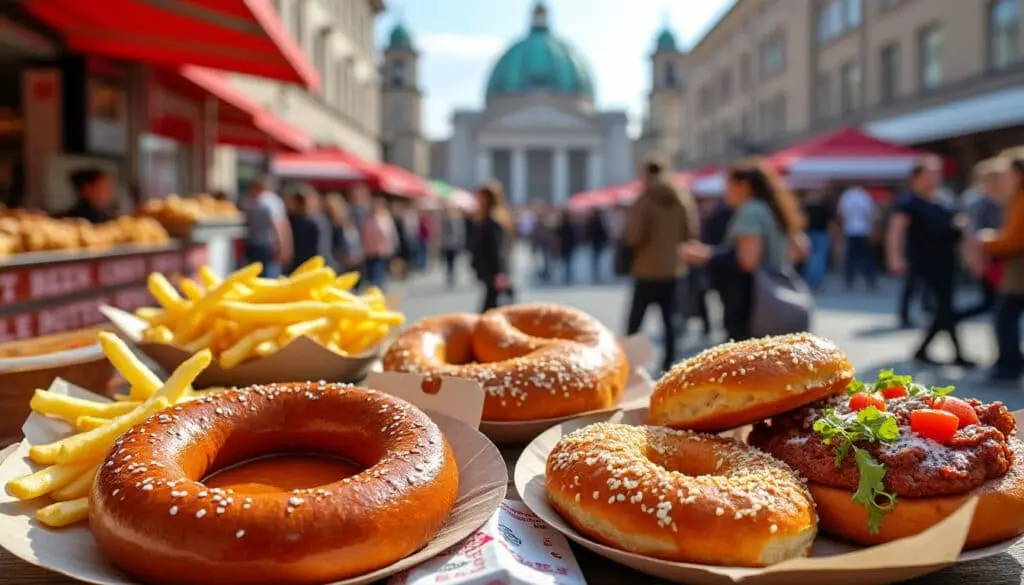
Berlin has transformed from a city with a modest culinary reputation into one of the most exciting food destinations in Europe — and the transformation has been astonishing. Today, Berlin offers an extraordinarily diverse and dynamic dining scene that ranges from legendary street food and outstanding immigrant cuisine to Michelin-starred fine dining and some of the most inventive contemporary restaurants on the continent. Whatever you want to eat, whatever your budget, whatever time of day — Berlin will feed you magnificently.
This guide covers the essential dishes, the best neighborhoods for eating, and some of the standout restaurant experiences the city has to offer. Come hungry.
Essential Berlin Street Food
Currywurst
You cannot visit Berlin without eating Currywurst. This is not just a dish — it is a civic institution. Invented in Berlin in 1949 by Herta Heuwer, who reportedly mixed ketchup with Worcestershire sauce and curry powder and poured it over a grilled pork sausage, Currywurst has been one of the city’s defining foods for over 70 years. It is served sliced, drenched in the sauce, dusted with curry powder, and accompanied by chips or a bread roll (Brötchen). It is cheap, filling, and deeply satisfying.
The best Currywurst in Berlin is debated with great passion. Long-established street stands throughout the city serve the dish, and the quality varies. Seek out a stand with visible queues of locals rather than tourists for the best experience. The Currywurst Museum in Mitte is also worth a visit for the culturally curious.
Döner Kebab
Berlin has a serious claim to having the best döner kebab in the world outside Turkey itself — and many Turks would not dispute it. The city’s large Turkish and Kurdish community, which has been here since the 1960s, has had decades to perfect the craft, and the Berlin döner — served in a freshly baked flatbread with slowly roasted meat, fresh salad, and house-made sauces — is a revelatory experience for anyone who has previously only encountered the mass-produced version. Kreuzberg and Neukölln are the heartland of Berlin’s döner culture.
Berliner Pfannkuchen
The Berliner — a jam-filled doughnut known in most of Germany as Berliner Pfannkuchen and simply as “Pfannkuchen” in Berlin itself — is the city’s most beloved sweet snack. Light, pillowy, generously filled with jam or occasionally custard, and dusted with powdered sugar, a good Berliner from a traditional bakery is one of life’s simple pleasures. They are available from bakeries throughout the city and are best eaten still slightly warm.
Best Neighbourhoods for Eating
Kreuzberg and Neukölln
Kreuzberg is the neighbourhood that best exemplifies Berlin’s extraordinary culinary diversity. Turkish and Kurdish restaurants dominate, but you will also find outstanding Vietnamese, Indian, Middle Eastern, and Levantine food at prices that remain remarkably affordable. The Bergmannstrasse (Google Map)area is excellent for a more relaxed café and restaurant experience, with a good mix of brunch spots, pizza, and Italian food alongside more international options. Neukölln, directly south, has become increasingly interesting for food in recent years — particularly around Karl-Marx-Strasse and the streets around Körnerpark.
Prenzlauer Berg
Prenzlauer Berg is Berlin’s brunch capital. This beautifully preserved neighborhood in former East Berlin is lined with cafés and restaurants that serve generous, creative brunches throughout Saturday and Sunday — and often on weekdays too. Expect eggs a dozen ways, avocado toast, excellent sourdough, fresh juices, and very good coffee. The queues at the best spots can be significant on weekend mornings, but the atmosphere is so pleasant — tables outside when weather permits, leafy streets, young families and creative types — that waiting is not a hardship. For evening dining, Prenzlauer Berg offers a good range of bistros and restaurants, particularly around Helmholtzplatz.
Mitte
Mitte is the neighbourhood with the greatest concentration of fine dining, upscale restaurants, and high-profile hotel restaurants. The area around the Gendarmenmarkt — arguably Berlin’s most beautiful square — is lined with excellent restaurants of varying price points. The Hackesche Höfe courtyards offer a good mix of cafés, restaurants, and bars in a lovely setting. For a truly special meal, Mitte is where to look: several Michelin-starred restaurants are located here, offering some of the finest contemporary European cooking in Germany.
Charlottenburg
The western district of Charlottenburg offers a more traditional and upscale dining experience. The streets around the Kurfürstendamm and its side streets are home to some of Berlin’s most established and celebrated restaurants, particularly for traditional German cuisine and classic French cooking. Charlottenburg is also where you will find some of Berlin’s finest hotel restaurants and some of the most elegant bar and cocktail experiences in the city. See our Berlin bars guide for recommendations.
Fine Dining in Berlin
Berlin’s fine dining scene has come into its own over the past decade and a half. The city now has multiple Michelin-starred restaurants, and the broader quality of ambitious restaurants — those just below the starred level — is very high. Berlin’s fine dining tends to embrace a particular sensibility: ingredient-focused, seasonal, influenced by German traditions but open to global techniques, and often served in spaces that feel relaxed and unstuffy compared to their equivalents in Paris or London. This is fine dining with a Berlin character — serious about food, casual about formality.
The most celebrated restaurants in the city change with some frequency, so checking current recommendations from food publications closer to your visit is advisable. What remains consistent is that Berlin’s best restaurants represent outstanding value by the standards of comparable restaurants in other European capitals — the quality-to-price ratio in Berlin’s fine dining scene is genuinely remarkable.
Berlin’s Café Culture
Berlin takes its coffee seriously. The city’s café scene has exploded in the past decade, with independent specialty coffee roasters and café-bars appearing throughout the cooler neighborhoods. The standard of espresso-based drinks and filter coffee across the city is extremely high, and the cafés themselves are often lovely spaces — converted industrial buildings, repurposed communist-era shops, plant-filled rooms with battered furniture and excellent playlists. Prenzlauer Berg, Kreuzberg, Neukölln, and Friedrichshain are the best neighbourhoods for café culture.
For a more traditional experience, the old-fashioned Café und Konditorei — a café and cake shop — still exists in various corners of the city. These establishments serve proper filter coffee, elaborate layer cakes, and a sense of an older, slower Berlin that is increasingly hard to find. Café Kranzler on the Kurfürstendamm, Café Einstein Unter den Linden, and various establishments in Charlottenburg and Schöneberg are worth seeking out for this experience.
Markets and Food Halls
Berlin’s food markets are among the best in Germany. The Turkish Market on Maybachufer in Neukölln (Tuesday and Friday afternoons) is the finest — see our Kreuzberg guide for details. The Markthalle Neun in Kreuzberg is a beautifully restored 19th-century market hall that hosts a weekly Street Food Thursday event and a Saturday farmers’ market, alongside permanent food vendors selling excellent bread, cheese, meat, and produce. The Winterfeldtmarkt in Schöneberg (Wednesday and Saturday mornings) is one of the city’s most beloved farmers’ markets, with outstanding produce and a wonderful neighborhood atmosphere.
Practical Dining Tips for Berlin
A few practical notes will help you eat well in Berlin. Cash is still important — many smaller restaurants, street food vendors, and market stalls do not accept cards, so carry euros. Tipping follows German convention: round up or add around 10%, telling the server the total amount you want to pay including the tip when settling. Many Berlin restaurants do not take reservations — particularly the more casual neighborhood spots — so be prepared to queue at peak times. For the most popular brunch spots on weekends, arriving by 10am avoids the worst of the queues.
Dining hours in Berlin tend to run later than in many other cities — restaurants fill up from 8pm onwards, and kitchens in many establishments stay open until midnight or later. This is a city that does not rush its evenings.
For full practical advice on visiting Berlin, see our Berlin travel tips page. For the nightlife and bar scene that rounds out a perfect Berlin evening, visit our Berlin bars and nightlife guide. And for help getting around the city between meal times, see our guide to getting around Berlin.
Berlin’s Food Scene: A City That Feeds You Well
Berlin’s food scene is one of the great pleasures of visiting this city — diverse, unpretentious, endlessly surprising, and remarkably affordable. Whether you eat a three-euro Currywurst standing at a street kiosk or spend an evening at a Michelin-starred restaurant in Mitte, you will find that Berlin feeds you with the same generous, unselfconscious spirit that characterises everything best about this extraordinary place. Come hungry, eat freely, and let the city’s remarkable culinary diversity delight you.
Find more inspiration for your Berlin visit at GoVisitBerlin.com.