If Berlin is one of the great city travel experiences in Europe, then Potsdam is the perfect companion — a city of extraordinary palaces, romantic gardens, and royal history that lies just 30 minutes from central Berlin by S-Bahn and represents one of the finest and most accessible day trips on the continent. A UNESCO World Heritage Site, home to some of the most beautiful 18th-century architecture in Germany, and set within a landscape of lakes and forests that inspired generations of Prussian kings and queens, Potsdam is not just a side trip from Berlin — it is a destination in its own right. But it pairs so magnificently with the capital that combining the two makes for one of the great travel itineraries in Germany.
Many visitors to Berlin make the mistake of treating Potsdam as a brief excursion — a quick look at a palace and back on the train. Do not do this. Potsdam rewards a full day, ideally more than one, and reveals itself most fully to those who explore it at leisure, walking through its extraordinary parkland, discovering its lesser-known corners, and lingering in the kind of grand, unhurried beauty that Prussian royal taste created with such ambition.
Sanssouci Palace: The Jewel of Potsdam
The centrepiece of any visit to Potsdam is Sanssouci Palace — Frederick the Great’s summer residence and one of the finest examples of Rococo architecture anywhere in Europe. Built between 1745 and 1747 to designs approved and co-created by Frederick himself, Sanssouci was conceived as a private retreat where the philosopher-king could escape the formalities of court life at the Berlin Palace. Its name — French for “without care” — perfectly captures the spirit in which it was conceived.
The palace is relatively small by royal standards — a single-storey building of just ten rooms, stretched along a terrace above six stepped vineyard terraces — but its interiors are of breathtaking richness. The Marble Hall, the Concert Room, the Library (Frederick was an intellectual of genuine distinction), and the royal bedroom are all decorated with an exquisite lightness and elegance that is entirely characteristic of Frederick’s personal taste. The garden facade, with its curved central bay looking out over the terraces to the park, is one of the most beautiful architectural compositions in Germany.
Visiting Sanssouci requires a timed ticket, which must be booked in advance during peak season (spring through autumn) — the palace is extremely popular and the number of daily visitors is strictly limited to protect the interiors. Book well ahead on the official Prussian Palaces and Gardens Foundation website.
The Sanssouci Park: A Royal Landscape
Surrounding Sanssouci Palace is the magnificent park of the same name — 290 hectares of landscaped gardens, woodlands, fountains, and further palace buildings that together form one of the great designed landscapes of 18th-century Europe. The park is a UNESCO World Heritage Site in its own right and can be explored freely at any time.
Walking through the Sanssouci Park is one of the great pleasures of a visit to Potsdam. Every turn reveals another magnificent building, another carefully composed vista, another surprise: the Chinese House, a delightful Rococo teahouse decorated with gilded figures; the Orangery Palace, a long Italianate building of impressive scale; the New Palace, a massive Baroque pile built by Frederick to demonstrate Prussia’s power after the Seven Years’ War; the Charlottenhof Palace, a more intimate neoclassical structure in the southern park; and the Roman Baths, a picturesque complex of buildings modeled on Italian architecture and set around a garden of extraordinary beauty.
A full circuit of the park on foot takes several hours — a bicycle, rentable from stands near the park entrance, is a wonderful alternative that allows you to cover more ground and visit buildings that would be too far to walk between conveniently. Allow at least half a day for the park alone.
The New Palace: Prussian Power Made Visible
At the western end of the Sanssouci Park stands the Neues Palais (New Palace) — a vast, imposing building that represents a very different aspect of Prussian royal taste. Built between 1763 and 1769 after the end of the Seven Years’ War, it was intended by Frederick the Great as a statement of defiance: Prussia had survived a war against several major European powers simultaneously, and the New Palace — enormous, boldly decorated, and expensive — was his way of showing that the kingdom’s resources remained intact.
The New Palace is remarkable for its sheer scale and the richness of its state rooms. The Marble Gallery, the Grotto Hall, and the Theatre — one of the best-preserved 18th-century court theatres in Europe — are all extraordinary spaces. Unlike Sanssouci, the New Palace does not require advance booking in the same way, though checking ahead is always advisable.
Potsdam’s Dutch Quarter and Historic City Centre
Beyond the palaces and their park, Potsdam’s historic city centre is well worth exploring. The Dutch Quarter (Holländisches Viertel) is a charming neighbourhood of early 18th-century red-brick houses built by Dutch craftsmen who came to Potsdam at the invitation of Frederick William I (Frederick the Great’s father, a very different character — a soldier-king who valued Dutch efficiency and craft skills). The Dutch Quarter is one of the best-preserved groups of Dutch urban architecture outside the Netherlands, and its streets are lined with cafés, boutiques, and restaurants that make it a pleasant place to spend a morning or afternoon.
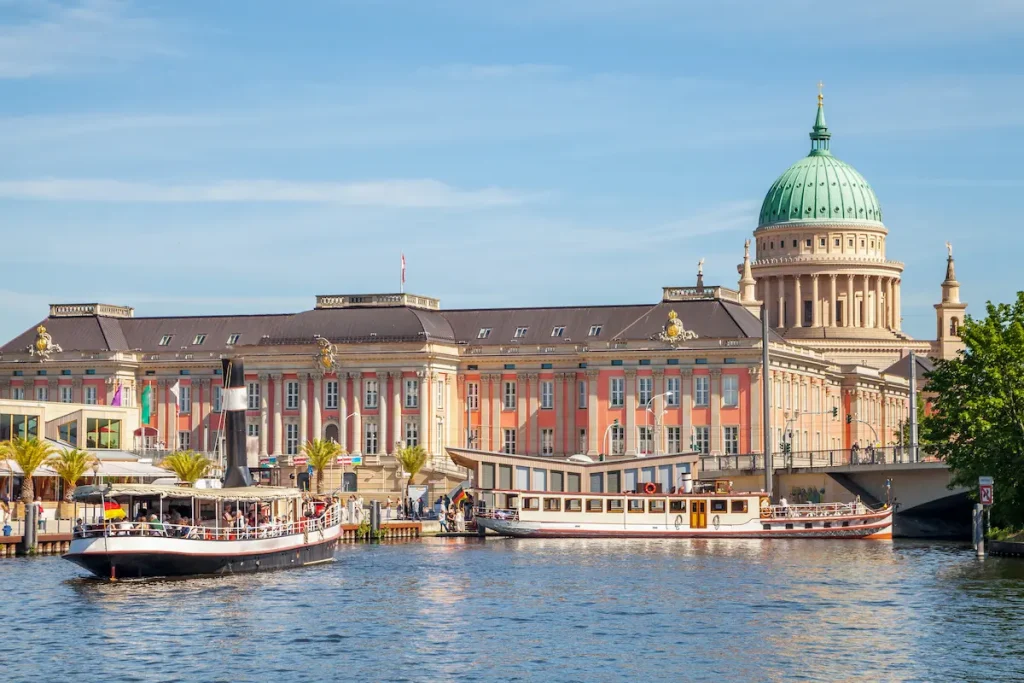
The city’s historic market square, the Alter Markt, has been largely rebuilt after wartime destruction and is dominated by the reconstructed Potsdam Palace — the Stadtschloss — now housing the Brandenburg state parliament. The nearby Church of St Nicholas, a superb neoclassical building with a striking dome, is worth a visit for its architecture and for the views from the tower.
Cecilienhof Palace and the Potsdam Conference
On the northern edge of Potsdam, in the park of the New Garden (Neuer Garten) on the shores of the Heiliger See, stands Cecilienhof Palace — a charming English-style country house built in 1917 as the home of Crown Prince Wilhelm and his wife Cecilie. Cecilienhof might be modest compared to the grand baroque and rococo palaces of the Sanssouci Park, but it carries immense historical significance: it was here that Stalin, Truman, and Churchill (later replaced by Attlee) met in July and August 1945 for the Potsdam Conference — the last great summit of the Allied powers, which determined the post-war division of Germany and Europe.
The conference rooms at Cecilienhof are preserved largely as they were in 1945, and visiting them — seeing the round conference table, the delegation rooms, the garden where the leaders met for informal discussions — is a remarkable historical experience. The New Garden surrounding the palace is a beautiful landscape in its own right, with a Gothic library and an underground ice cellar among its eccentricities.
Getting to Potsdam from Berlin
Potsdam is remarkably easy to reach from Berlin. The S-Bahn line S7 runs directly from Berlin Hauptbahnhof and other central Berlin stations to Potsdam Hauptbahnhof in approximately 30 minutes. Regional trains (RE1) also run frequently and take slightly less time.
The journey is included in the Berlin ABC zone ticket — make sure you buy a ticket that covers Zone C, which includes Potsdam.
From Potsdam Hauptbahnhof, the Sanssouci Park is about 20 minutes on foot or a short bus or tram ride. Bikes can be hired at the station and are the ideal way to explore the park and the wider city. For all transport advice within Berlin and for the journey to Potsdam, see our guide to getting around Berlin.
Practical Tips for Your Potsdam Day Trip
Book tickets for Sanssouci Palace well in advance, especially between April and October — the palace fills up quickly and the timed entry system means you cannot simply turn up and get in. The park is free to enter and wander at any time, but the individual palaces all charge entry fees.
Wear comfortable walking shoes — the park is large and the paths, while well maintained, cover significant distances. A picnic in the park is highly recommended: buy provisions in Berlin before you leave, or from the shops and markets in central Potsdam. The park’s own cafés are pleasant but can be busy in high season.
The best time to visit Potsdam is spring and autumn — the park is gloriously beautiful in spring blossom and autumn colour, and the summer crowds are thinner than in July and August. That said, summer visits have their own magic, with the fountains playing and the vineyard terraces in full greenery. Check our best time to visit Berlin guide for seasonal advice that applies equally to Potsdam.
Why Potsdam Belongs on Every Berlin Itinerary
Potsdam is everything that Berlin is not — intimate rather than vast, serene rather than intense, royal and aristocratic rather than democratic and countercultural. And that contrast is precisely what makes the combination so rewarding. After days of engaging with Cold War history, world-class museums, and the energy of a great European capital, a day in Potsdam’s parkland palaces offers a profoundly restorative counterpoint. Go, wander slowly, and let the beauty of Frederick the Great’s “care-free” retreat work its magic on you.
For all the information you need to plan your Berlin and Potsdam trip, explore GoVisitBerlin.com and visit our Berlin travel tips page.